

Designing with Nature in Mind: Biophilic Bedroom Layouts That Boost Wellbeing
See how strategic layout, natural light, indoor plants, and nature-inspired textiles can enhance both your space and your state of mind.
What is Biophilic Design?
The term “biophilia” literally means “love of life” and was popularized by German psychoanalyst Erich Fromm in the 1960s to describe humanity’s love of all living beings. American biologist Edward O. Wilson developed the concept further in his book, Biophilia (1984), claiming that we have an innate need to connect with nature. Biophilic design, therefore, is design that fosters this connection.
One of the pioneers of biophilic design was Stephen Kellert, professor of social ecology at Yale University. In “The Practice of Biophilic Design,” co-authored with Elizabeth F. Calabrese, he states that there are three main attributes of biophilic design:
- Direct Experience of Nature
The direct experience of nature can include the experience of light, air, water, plants, animals, weather, natural landscapes, and fire. Kellert cites the inclusion of plants as one of the most successful biophilic strategies but also emphasizes the importance of natural ventilation and light exposure.

- Indirect Experience of Nature
Indirect experience of nature takes many forms: they can be paintings or photographs, but also the use of natural materials, aged materials with a patina, nature-inspired colors, and nature-inspired forms. For instance, Kellert cites the “wings” of the Sydney Opera House or the “rose-like” windows of Notre Dame as shapes that draw inspiration from nature, even if they do not occur in the natural world.
- Experience of Space and Place
This concept is a little harder to grasp than the other two—generally, it draws inspiration from nature’s broader attributes, as well as from human psychology. For example, Kellert states that biophilic architecture must have both “prospect” (a view of the outdoors) and “refuge” (secure and sheltered settings). Kellert also advocates for organized complexity: “the most satisfying settings tend to possess qualities of complexity but experienced in an orderly and organized way.”
Biophilic design has several benefits for our health and wellbeing. In healthcare, a range of studies have found that exposure to nature—or even just a view of it—can lower blood pressure, reduce stress, reduce pain, accelerate healing, and improve the morale of both patients and healthcare workers.

How to Design a Biophilic Bedroom
Kellert’s principles were created with buildings and even cities in mind, but they can also be applied on a smaller scale. Here, we’ll share practical tips on designing a biophilic bedroom with nature in mind.
Use Indoor Plants
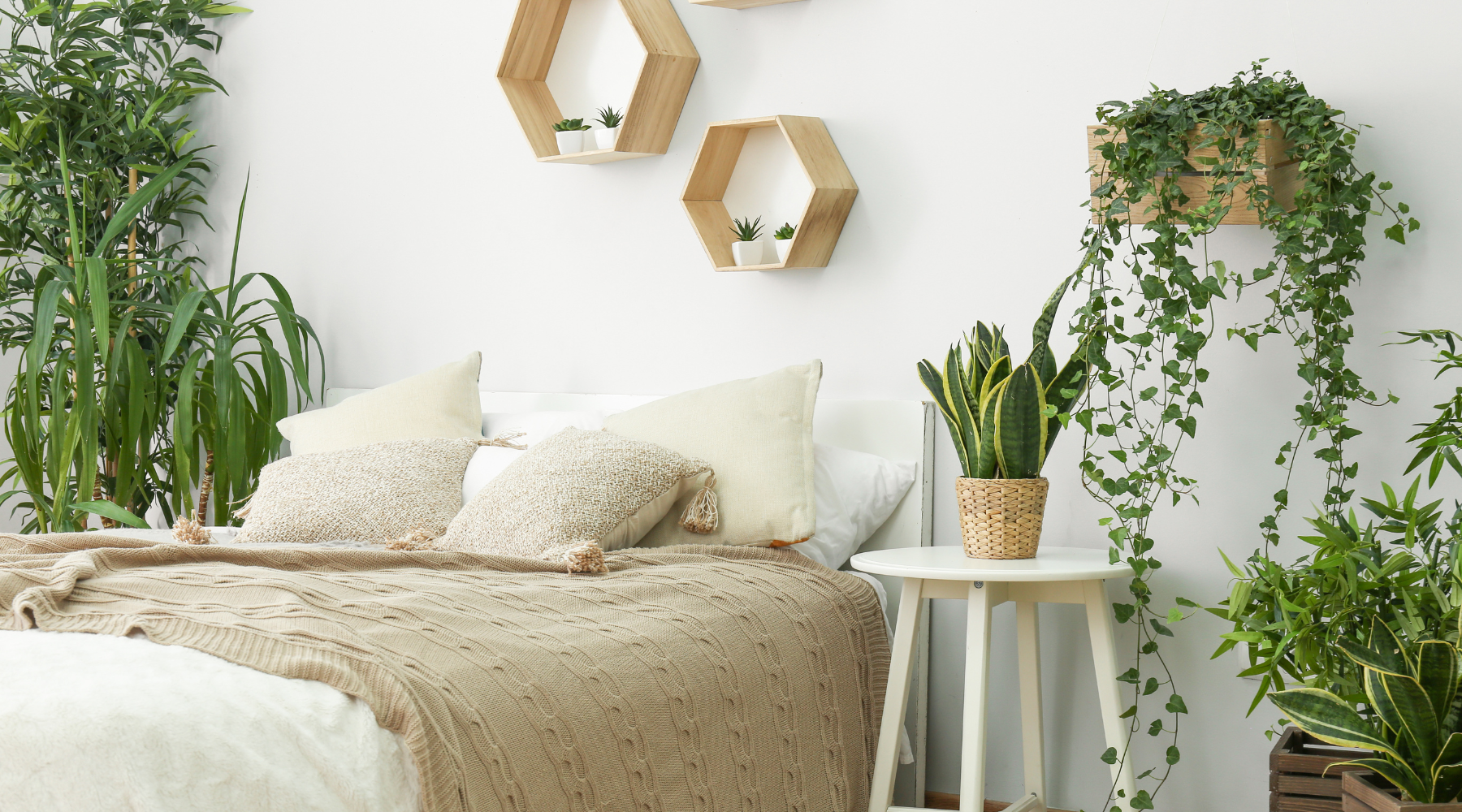
Plants are a given in biophilic design, but Kellert says that we might not be going far enough. “The application of single or isolated plants rarely exerts much beneficial effect,” he says. “Vegetation… should be abundant, ecologically connected, and tending to focus on local rather than exotic and invasive species.” If you’re short on surface space, you can mount planters on your wall or hang them from the ceiling. An over-the-bed shelf with trailing plants is also a great way to achieve that abundance. Obviously, we won’t tell you to get rid of your tropical plants, but it might be worth researching local species and including them in your space. This will bolster another key concept of biophilic design: a sense of ecological and emotional attachment to your local area.
Maximize Natural Light and Air
Exposure to natural light is essential to wellbeing—and can help you to wake up on darker winter mornings. Natural ventilation, too, helps maintain a cool and comfortable environment for sleeping at night. Make sure you have a full view of the window, with nothing blocking it; if your windows are too small, Kellert suggests investing in lights that “mimic the spectral and dynamic qualities of natural light.” Many brands of smart bulb now have settings that will change color temperature according to the time of day, helping you both wake up and get to sleep.

Use Natural Materials and Forms
Natural materials such as wood, leather, and wool create a feeling of calm and connection with the natural world—this is particularly important in the bedroom, where tactile textures help to relax us as we wind down. Our organic linen duvet covers are made from European Flax, which grows naturally in the flax fields of northern Europe. Not only is it hypoallergenic and great for sensitive skin, it has a beautiful, tactile texture that works perfectly in a biophilic bedroom. When choosing bedroom furniture, go for softer, nature-like forms rather than hard, geometric lines. Bonus points if you shop second-hand—not only is it better for the environment, but vintage items have a beautiful patina that’s hard to recreate artificially.
Use Natural Colors and Images
Studies have shown that in the absence of real plants, even images of plants have a beneficial effect on wellbeing. These can take many forms: paintings, photos, sculpture, wallpaper, and much more. Our European duvet covers are printed with images of Scandinavian flora and fauna, so you’ll experience nature’s beneficial effects the moment you wake up in the morning and the moment you fall asleep at night. Regarding colors, Kellert says we should use “muted ‘earth’ tones characteristic of soil, rock, and plants. The use of bright colors should be cautiously applied, and emphasize…flowers, sunsets and sunups, rainbows, and certain plants and animals.”

Get Organized
A biophilic bedroom should find a balance between organization and complexity. If you’ve followed our tips so far, that complexity will be provided by the plants, prints, and textures you’ve brought into your space. Now, it’s time to clear out the clutter. Your bedroom should be restful, not stressful, and easy to move around, without anything blocking doors or closets. Kellert also asserts that “people covet settings where disparate parts comprise an integrated whole,” advocating for the creation of a functional or thematic focal point.
In the bedroom, the bed is the natural focal point, so might we suggest emphasizing it with a set of our Scandinavian-style duvet covers? Whether you love Scandinavian plants such as oak and chervil, or prefer a solid-color set in nature-inspired green or grey, you’re bound to find a set you’ll love.
Have you heard of biophilic design? Which of these tips will you apply to your own home? Let us know on Instagram, Pinterest, Facebook or Twitter!
Read more

Eco Essentials: Comparing Linen With Tencel, Bamboo, and Hemp Bedding
Looking for the most eco-friendly, sustainable fabric? See how linen measures up against Tencel, bamboo, and hemp.
Read more
Transitioning Your Bedroom for Fall, the Scandinavian Way
See how to create a cozy, Scandinavian-style fall bedroom using hygge-inspired tips—from earthy tones and layered textures to soft and warm lighting.
Read more

Leave a comment
This site is protected by hCaptcha and the hCaptcha Privacy Policy and Terms of Service apply.